
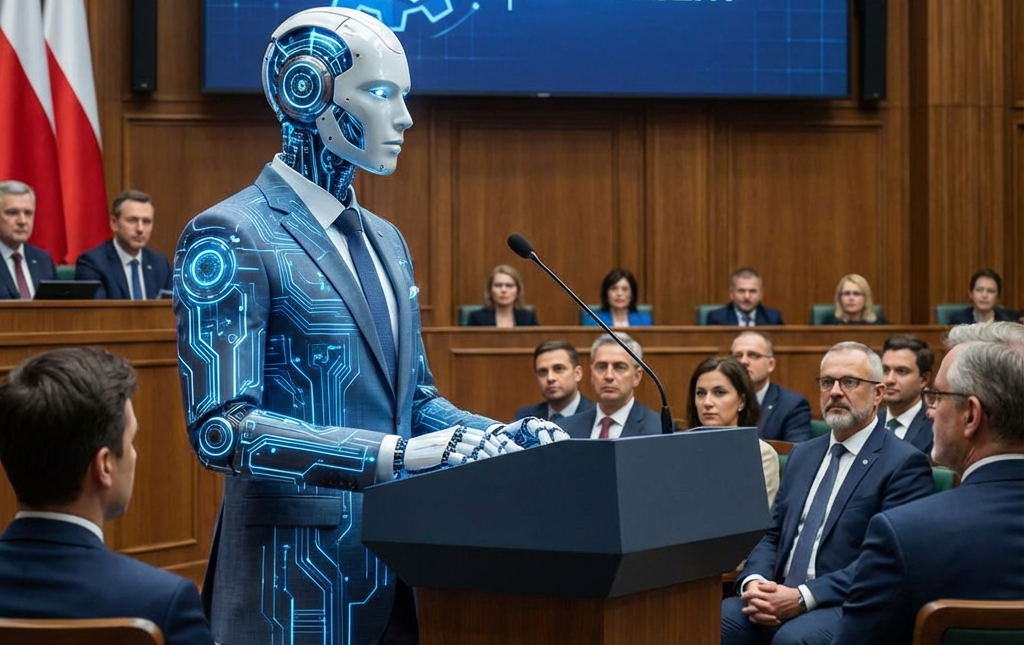
The concept of a digital proxy capable of recognising a citizen's political preferences with a precision equal to – or exceeding – their own self-awareness, monitoring every legislative initiative and casting votes in real time, was until recently the stuff of science fiction. Now it is becoming technically feasible. Although delegating political representation to artificial intelligence systems may seem radical, the concept is based on a fundamental truth about modern political systems: representative democracy exists primarily because not all citizens can participate directly in every decision-making process.
Structural limitations of representative democracy
Information deficits in political communication
Representative democracy requires elected representatives to aggregate and represent the preferences of their electorate. The most obvious justification for this model is logistical constraints: citizens do not have the time or the means to communicate their preferences directly on every public decision, and it is impossible for all eligible voters to participate physically in legislative deliberations.
This system has significant shortcomings. Citizens elect representatives and convey messages of varying degrees of precision – often vague or even ambiguous – about their expectations, and then entrust them with the task of extrapolating the details. Election campaigns are usually constructed around a few key issues – such as immigration, taxation or healthcare – with each candidate taking a specific position on these areas. The winner of the election interprets the result as a mandate to decide on other issues independently. Mechanisms for additional signalling of preferences, such as referendums or citizens' initiatives, are rare. Although elected representatives consult directly with part of the electorate, these consultations are usually limited in scope, and collective signals are derived from opinion polls and social media. The result is an insufficient exchange of information between citizens and their representatives, which makes it difficult to ensure that the actions of representatives are in line with the preferences of their constituents.
The technological transformation of democratic participation
Artificial intelligence has the potential to revolutionise the functioning of democracy to an extent that exceeds the impact of any previous technology. In their publication "Rewiring Democracy: How AI Will Transform Our Politics, Government, and Citizenship", the authors argue that the impact of AI on democratic systems may prove unprecedented, partly due to the unique ability of this technology to transform verbal communication into autonomous action. Unlike passive tools, AI agents can perform tasks—from simple commands to complex sequences of actions—on behalf of anyone who can formulate an instruction. As AI becomes integrated into connected digital systems, its potential impact on political processes, including lobbying and even voting, will steadily increase.
AI systems could identify citizens' views, extrapolate their political preferences, and act on their behalf. It is likely that this process will begin in non-governmental contexts. AI proxies have already been proposed as a mechanism for voting on behalf of investment funds that control corporate shareholder votes. In the case of citizens, a personal AI assistant trained on the basis of their political preferences and constantly adapting to their evolution could advise on the allocation of political donations, the selection of candidates or support for referendum initiatives. Online platforms offering such functionality based on a short questionnaire already exist; a personal AI assistant could be a much more advanced instrument of political navigation.
The shift in the balance of power: from the legislature to direct democracy
As AI becomes more widespread in government structures, there may be a shift in the balance of power between legislators and citizens. In particular, these systems could make citizens' initiatives – as a form of direct democracy – a more effective and efficient mechanism for law-making, which would transfer the process of public policy-making from legislators directly to citizens.
Limitations of contemporary mechanisms of direct democracy
Nowadays, most referendums are strictly binary in nature: the proposal is precisely defined, and citizens vote "for" or "against". In such a system, even socially desirable political solutions may be rejected if the wording of the proposal is not optimal. Supporters of a rejected initiative may be forced to wait years for the next election cycle to make another attempt. This limitation makes direct democracy much less flexible than the legislative process conducted by elected representatives, who have the power to negotiate, exchange concessions, compromise and iteratively refine draft legislation, as well as to vote repeatedly until a consensus is reached.
AI as an instrument for expanded civic participation
An AI system trained to recognise individual preferences could act as a personal political representative. Individual voters are deprived of these options due to their large numbers and time constraints. The lack of time to vote every day and to study dozens of political issues or analyse the legal language of bills considered by legislatures is a significant barrier to participation.
The AI agent could develop an advanced understanding of the user's political preferences and support them in making voting decisions. If a position on a new issue is clearly derived from previous behaviour – such as voting history and previous interactions with the AI – the system would not need to consult the user. In case of uncertainty about the position, the AI could ask clarifying questions. If the user trusts their AI proxy to provide relevant contextual information, this could eliminate the need for independent research. With proper design of such tools and their acceptance by both citizens and officials, government institutions could become more responsive to the public voice and increase their effectiveness. This vision, of course, involves numerous conditions and hypothetical assumptions about trust, but it is a natural extrapolation of the advocacy tools discussed in detail in the authors' publication.
AI agents could encourage increased voter turnout. The most obvious way in which AI can improve the current situation is by supporting citizens in responding to an increased number of referendum initiatives. Today, non-partisan voter guides, presenting arguments for and against each initiative, are a valuable tool to support electoral decisions. However, these guides often contain several densely packed pages on each question, which limits their scalability for human readers. If AI made electoral decision-making easier, citizens could vote in a much larger number of referendums. Future ballot papers could contain hundreds of items and be used more frequently, allowing voters to control public policy with an unprecedented level of detail.
Speculative scenarios of full political delegation
In a more speculative scenario, voters could authorise an AI proxy to vote on their behalf. If voters were individually represented by effective, efficient, and trustworthy AI proxies, they could be consulted—through their proxies—more frequently and in greater depth. Referendum initiatives would not need to be binary or synchronised with electoral cycles. Through their proxies, voters could be consulted on an ongoing basis and with an expanded set of options, allowing for a much more nuanced representation of their individual and collective preferences.
Even more radically, AI could facilitate a new form of direct democracy, in which a combination of voters and their AI proxies would collectively make political decisions. One could imagine a political system in which a personal AI, trained on the basis of the user's desires, needs, beliefs, value system and political preferences, becomes their personal representative in a mass legislature, where millions of such proxies collectively debate and then vote on legislation. When issues of particular importance to the user were being debated, their AI assistant could request that their opinion be presented directly and their vote cast.
Extension of rights to unrepresented groups
This vision certainly deviates from the contemporary model of democracy, but scientists are developing AI tools that could enable these new forms of governance in the future. Computer scientists are currently developing a concept called "generative social choice," in which AI systems learn individual political preferences and then collectively and iteratively generate policy proposals that a clear majority of the people involved would agree with. Ultimately, such systems could even propose legislative wording.
AI representatives could support the representation of the interests of those without voting rights in the legislative process: children, animals, and even future generations. We could instruct AI proxies to represent the interests of these groups appropriately. This does not mean granting voting rights to specific AI entities, but it could imply that deliberation and policy formulation would include AI representatives who favour, for example, policies that support forest conservation.
To those unfamiliar with the issue, this may sound like fantasy, but the challenge of internalising entities without a voice in the political system is a well-researched problem in economics, law and political science. UN conventions call for the representation of children in legal proceedings. Hundreds of jurisdictions recognise ‘rights of nature’, analogous to human rights. The development and integration of AI systems that communicate directly on behalf of these excluded groups may be one way to achieve this goal. Going further, if AI systems currently being developed to communicate with animals achieve significant progress, established concepts of non-human representation will take on new meaning.
Protecting the integrity of AI-assisted democracy.
Challenges related to trust and risks of manipulation
The implementation of AI proxies could, of course, have adverse effects. Firstly, as discussed in many contexts, it would require a great deal of trust between voters and their AI proxy. The system will not work if the user fears that it may misunderstand their intentions or misrepresent the referendum question. It will not work if the agents are inherently biased towards someone's views, such as those of the corporation that created it. Nor will it work if the user has to fear that their AI will be hacked.
AI may misrepresent the user in voting. AI proxies may not accurately represent political views. An AI system extrapolating from one response to another may be mistaken. This is a classic problem in both statistics and AI; there are methods for understanding when a predictive system does not generalise correctly from one domain, such as one type of referendum question, to another. An AI proxy can predict the answer to a new political question – real or simulated – and consult with the user on the result. If the agent is wrong, the user can inform it, thereby updating both the tool's understanding of the frequency of consultation and their own understanding of its reliability. Everyone will have a different tolerance for this kind of error, so the AI agent can be trained to consult with the owner as often as they deem appropriate.
Potential for increasing governmental fairness
Good AI representation could make government more equitable. Democracy is slow, redundant, and often regressive. Political uncertainty also occurs in traditional representative democracy, but it usually resolves relatively slowly. Laws are repealed and replaced, amended, challenged in courts, and updated ad nauseam over years. Sometimes political changes are so chaotic that their implementation is halted while the legislature, courts, or voters try to figure out what they really mean. This often points to an unstable equilibrium, a formulation of policy susceptible to easy overthrow by pressure from any direction. With better representation of our collective preferences, we can find more stable policy formulations. Society as a whole would benefit if AI could help develop policies that are truly better for the people they affect and require less political struggle to implement and maintain.
AI proxies could make minority voices more meaningful. The most optimistic reason for developing such systems is to make government more equitable. One problem with representative democracy is that it can be anti-majoritarian. Citizens do not each get their own representative; entire communities vote to elect one person to represent everyone. If the democratic system does not use proportional representation, and you belong to a demographic group that consistently constitutes a minority in constituencies (possibly due to gerrymandering), you may be persistently unrepresented. Equally problematic is that many representative bodies, such as the US Senate or the Japanese National Diet, do not distribute representation according to population, so some groups have even less power than their numbers would suggest. Even direct democracy can be unfair in practice, as voter turnout is often lower among less affluent or less motivated groups. If everyone had equal access to an AI proxy, barriers to participation could be lowered, if not eliminated, and everyone could have a more equal voice.
In general, rather than our democratic systems of preference aggregation being limited by human capacity for complexity, they would be limited by AI's vastly greater capacity for complexity.
A natural extension of representative democracy
A natural extension of representative democracy. How strange would a world be in which AI casts votes and makes decisions for us on a large scale? The authors argue that it would not be very strange at all. Every member of a complex society has experience of delegating the most important decisions affecting their lives to an impersonal machine.
Most of us want to believe that we can intervene when it matters. If an institution is acting in an aberrant, corrupt, or harmful manner, we can exert political pressure to force it to change its behaviour. We can recall elected officials for being irresponsible. We can use citizens' initiatives to force policy changes. We can picket outside the institution's headquarters. This collective individual expression will bring about change. If not, democracy is not working.
Risks of over-reliance on AI agents
Erosion of democratic capacity
AI could erode our democratic instincts. The most fundamental concern about implementing AI agents is that it could contribute to the atrophy of our innate capacity for democracy. Aristotle viewed democracy as a form of self-realisation. In this view, individual political preferences do not magically appear in our heads, waiting for AI to recognise them and advocate on our behalf. They are formed through a process of education, discussion and debate. The act of practising democracy is what makes democracy work. If we allow our AI proxies to fight it out among themselves and then tell us the result, we lose that human interaction. What's more, if we start listening to and believing the version of our preferences presented by AI, we may lose any sense of personal conviction. This could easily lead to the same kind of feedback loops that push people towards extreme views or entrench and polarise political parties. Replacing humans with AI may result in worse outcomes in the long run, even if it leads to better policy decisions in the short term.
Of course, the outcome depends on the application. We may be fine with AI driving our cars and forgetting how to drive ourselves – just as few of us know how to drive a horse-drawn carriage. We are probably not fine with AI passing all the laws while we humans forget how to practise democracy. Perhaps we will allow AI to help us deliberate and build consensus, but nothing more.
The need to strengthen political commitment
AI advocates should strengthen political engagement. The actual decisions made by the government, even in policy areas we care deeply about, are as remote to most of us as the biochemical reactions in our cells. Parents care deeply about their children's education, but most do not have time to read the texts assigned in public schools — let alone influence which texts are assigned. Citizens who care deeply about justice generally have no idea what cases are being heard in their local district court, let alone what rules are being applied or what qualifications the prosecutors and judges acting on their behalf have. It is simply impossible for citizens in a modern democracy to be informed about most of the ways in which government functions or to form opinions about them. For generations, the solution has been to entrust this authority to institutions. We even trust these institutions to choose technologies that help automate their work.
AI-assisted democracy depends on citizens remaining engaged. AI is just another step along the same path: another technological option for us to use in expressing our political preferences and for institutions to use in performing their functions. If we can trust AI, this may even be a positive step.
Most of these scenarios are too far in the future to predict clearly. What we want now is to strengthen human civic engagement, even as AI becomes indispensable as an enabling technology. In Rewiring Democracy, the authors explore more fully how society can maximise the benefits of AI for democracy while minimising its risks. Overall, they are hopeful that this technology will bring a net benefit to societies built on a foundation of individual freedoms. But like everything in democracy, realising these benefits will require all of us to be as well informed and engaged as possible.
It is often the case in human history that a specific technical solution is frequently applied in areas not anticipated by its creators, and ethical or legal barriers eventually succumb to the "temptation of implementation". Are we dealing with another taboo in this case? Will digital democracy become merely a stage on the road to digital totalitarianism? The answers to these questions will have to be sought by future generations.
And does the prospect of an AI "investment bubble" lead to a desperate search for new systemic implementations of this technology? If, in the coming months, further proposals for solutions that break further "mental taboos" appear, this hypothesis will gain serious confirmation. Will a special AI agent use our metadata to suggest our individual religion? We will find out soon.
Bibliography:
Bruce Schneier and Nathan E. Sanders, „Rewiring Democracy. How AI Will Transform Our Politics, Government, and Citizenship”, The MIT Press, 2025.